Three Card Tarot Spread Guide for Past Present and Future Readings
June 26, 2026 | By Finnian Grey
A three card tarot spread is one of the easiest ways to turn a broad feeling into a clearer reflection. Instead of asking the cards to explain everything at once, you give each card a simple role: where the situation has been, what is happening now, and what deserves attention next. That makes the spread useful for beginners, quick daily check-ins, love questions, creative blocks, and decision moments. If you want a low-pressure place to practice, a free online tarot reading space can help you explore the pattern while you learn how each position changes the meaning.
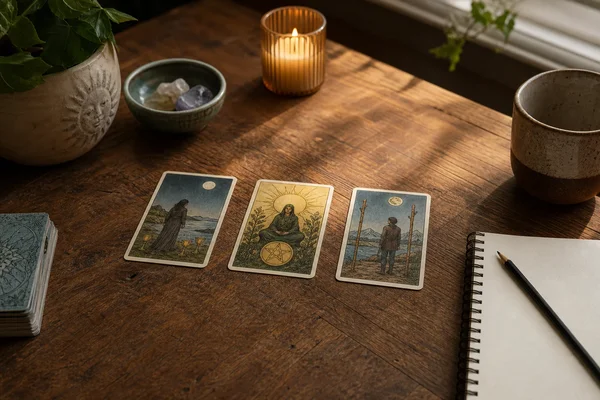
What a Three Card Tarot Spread Means
A three card tarot spread is a layout where each card has a defined position. The meaning comes from both the individual cards and the relationship between them. A card is not read in isolation; it answers the role assigned to its position.
The classic version is past, present, and future. The first card points to background influences, the second card reflects the current situation, and the third card suggests a possible direction if the same pattern continues. This does not make tarot a certainty machine. It gives you a symbolic structure for thinking through timing, choices, emotions, and next steps.
Three cards work because the spread is small enough to stay focused but large enough to show movement. One card may feel like a message. Three cards can become a short story.
Why three cards are enough
Large spreads can be useful, but they also ask the reader to track many positions at once. A three card spread keeps the reading readable. It lets you compare a beginning, a middle, and a possible next phase without losing sight of the original question.
This is especially helpful when you are new to tarot card meanings. You can spend more time noticing how the cards speak to each other instead of trying to remember ten separate positions. If The Star tarot card appears in the future position, for example, its themes of hope, renewal, and perspective may feel different than if it appears in the past position as an influence you are learning to trust again.
What each card position does
Each position acts like a lens:
- Card 1 gives context. It may show a past event, a habit, a hidden influence, or the emotional tone behind the question.
- Card 2 describes the present. It can show what is active now, what needs attention, or what is becoming clearer.
- Card 3 points forward. It may suggest an outcome, advice, a likely next theme, or the energy to bring into the situation.
The exact wording depends on the spread you choose. The important part is consistency. Decide what each card means before you draw, then read within that frame.
How to Do a Three Card Tarot Spread
You can do a three card tarot spread with a physical deck, a digital tarot tool, or a guided online reading. The method is simple, but a little preparation makes the interpretation much stronger.
1. Choose one focused question
Good questions create useful readings. Instead of asking, "What will happen to my life?" narrow the focus. Try:
- What should I understand about this situation right now?
- What pattern is influencing this relationship?
- What can I learn from the past, present, and next step?
- What do I need to consider before making this choice?
Questions that invite reflection usually work better than questions that demand a fixed prediction. Tarot is most useful when it helps you see your own assumptions, emotions, and available choices more clearly.
2. Pick the right three positions
Past, present, future is popular, but it is not the only option. Before you draw, choose a structure that matches your question. For a decision, "option one, option two, deciding factor" may be more useful. For a difficult mood, "mind, body, spirit" may be gentler. For a relationship, "you, the other person, the connection" may keep the reading balanced.
When the position names are clear, you are less likely to bend the reading toward the answer you already wanted.
3. Draw and place the cards
Pause for a moment, hold the question in mind, and draw three cards. Lay them left to right unless your chosen spread uses another pattern. You can read reversals if that is part of your practice, but beginners can also start upright only and still get a meaningful reading.
Write down the cards, positions, and first impressions before you look up detailed meanings. Your immediate reaction often reveals the emotional center of the question.
4. Read the cards as one story
After checking each card, step back and ask how the three cards connect. Do they move from tension to relief? From confusion to action? From waiting to choice? Do two cards share a suit, number, element, color, or repeated symbol?
This story layer is where three card tarot spread interpretation becomes richer. The spread is not only "card one means this, card two means that." It is also the relationship between the cards.
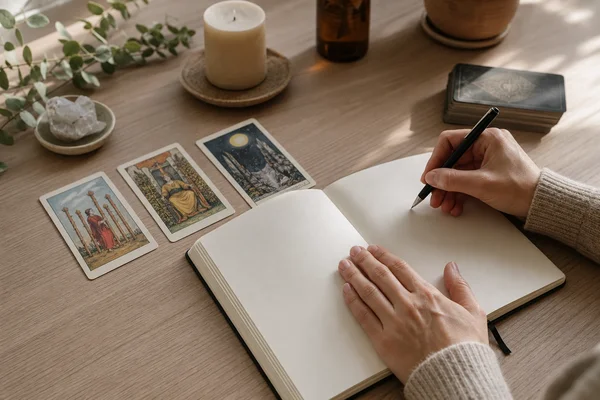
Common Three Card Tarot Spread Meanings
Different three card layouts answer different kinds of questions. The examples below give you practical options without making the reading complicated.
| Spread | Best for | Card positions |
|---|---|---|
| Past, present, future | General reflection and timing | Past influence, current energy, next direction |
| Situation, action, outcome | Choices and problem solving | What is happening, what to do, what may develop |
| Mind, body, spirit | Personal check-ins | Thoughts, physical state, inner meaning |
| You, them, connection | Relationship reflection | Your energy, their energy, shared dynamic |
| Strength, challenge, advice | Growth questions | Support, obstacle, helpful focus |
| Start, stop, continue | Habit change | Begin this, release this, keep doing this |

Past, present, future
The past, present, future spread is the best starting point for many readers. It is easy to remember and naturally creates a timeline. Use it when you want to understand how a situation developed and what direction it may be taking.
The future card should be read as a possibility, not a fixed verdict. If the third card feels difficult, ask what it is helping you notice. It may point to a pattern that can be changed, a boundary that needs attention, or an assumption that deserves review.
Situation, action, outcome
This layout is useful when you do not want to stay in analysis forever. The first card describes the issue, the second card suggests the kind of action or attitude that may help, and the third card shows the likely theme that follows.
For a three card tarot spread online, this can be a practical format because it turns a broad question into something you can reflect on immediately. You can use simple tarot reading tools to practice this structure and then journal your own interpretation in plain language.
Love and relationship questions
A three card tarot spread love reading should stay balanced. Avoid using tarot to make claims about another person's private thoughts as if they were facts. A healthier layout is:
- Your energy
- Their visible energy
- The connection between you
This keeps the reading focused on reflection, communication, and emotional patterns. It can help you notice whether you are projecting fear, ignoring your own needs, or reading mixed signals too narrowly.
New year and fresh-start readings
A three card tarot spread for new year reflection can be simple:
- What I am leaving behind
- What I am growing into
- What deserves steady attention
This works for birthdays, seasonal changes, job transitions, and any moment when you want a clean symbolic reset.
Three-Card Tarot Spread Questions to Ask
The best three-card tarot spread questions are open, specific, and grounded in your own choices. They should help you reflect rather than pressure the cards to deliver a single answer.
Try these question sets:
- What is the root of this situation, what is active now, and what needs care next?
- What am I seeing clearly, what am I missing, and what can I do with more awareness?
- What supports me, what challenges me, and what advice can I consider?
- What should I start, what should I stop, and what should I continue?
- What is my role, what is outside my control, and what is the next wise step?
For love or friendship:
- What am I bringing to this connection, what is the other person showing, and what is the relationship teaching me?
- What needs honesty, what needs patience, and what needs a boundary?
- What can I understand, what can I communicate, and what can I release?
For work or decisions:
- What is the current reality, what option has momentum, and what factor needs more attention?
- What is the risk, what is the opportunity, and what is the practical next move?
- What skill can I use, what obstacle may appear, and what support should I seek?

How to Read the Cards Without Getting Stuck
Many beginners freeze because they think every card has one correct meaning. Tarot card meanings are more flexible than that. The same card changes depending on the question, position, surrounding cards, and your honest reaction.
Use this quick reading checklist:
- Name the card and position.
- Write one traditional keyword.
- Write one personal impression.
- Connect it to the question.
- Compare it with the other two cards.
- End with one reflection or action you can actually use.
If a card feels confusing, do not force a dramatic answer. Look at the card's suit, number, imagery, and emotional tone. Cups often point to feelings and relationships. Swords may point to thoughts, conflict, truth, or communication. Pentacles often relate to the body, work, resources, or practical life. Wands may show energy, desire, creativity, or movement. Major Arcana cards often suggest larger themes or turning points.
Beginner Mistakes to Avoid
A three card spread is simple, but a few habits can make it less helpful.
First, avoid asking the same question again and again because you disliked the answer. Repeating the draw can create more confusion. If a reading feels unclear, write it down and return later.
Second, do not treat the future card as a final sentence. Read it as a direction, lesson, or likely theme based on the current pattern. That keeps the reading useful without making it feel fatalistic.
Third, do not ignore the question. If you asked about communication, read each card through that topic. If you asked about career direction, avoid turning every card into a love message.
Fourth, do not rush past your own response. The card meaning matters, but so does what it brings up in you. Tarot works best as a mirror for reflection, not as a replacement for your judgment.
Bring the Three Card Tarot Spread Into Your Practice
The three card tarot spread is worth returning to because it is flexible, memorable, and easy to adapt. You can use it for a free tarot reading three card spread, a journal prompt, a weekly reflection, or a quiet check-in before a decision.
For a simple practice, choose one layout and use it for a week. Keep the same positions each time so you can compare how different cards behave in the same roles. After each reading, write one sentence for context, one sentence for the current pattern, and one sentence for the next helpful focus.
When you want to explore without pressure, a beginner-friendly tarot reading practice can give you a place to draw cards, notice patterns, and build confidence with interpretation. Let the spread support your reflection, then bring your own values, common sense, and real-world information into any choice that matters.
FAQ
What is a three card tarot spread?
A three card tarot spread is a tarot layout with three defined positions. The most common version is past, present, and future, but the same three-card structure can also answer questions about love, choices, habits, personal growth, or next steps.
How do you read a three card tarot spread?
Read each card according to its position, then read all three cards as a connected story. Start with the question, check the individual meanings, compare repeated symbols or suits, and finish with one practical reflection you can use.
Is a three card tarot spread good for beginners?
Yes. It is one of the best tarot spreads for beginners because it is structured but not overwhelming. You only need to understand three positions, which makes it easier to learn card meanings and card combinations together.
Can I use a three card tarot spread for love?
Yes, but use balanced questions. Instead of trying to prove exactly what someone feels, ask what you are bringing, what the other person is showing, and what the connection needs. This keeps the reading reflective and respectful.
What is the best three card tarot spread for daily guidance?
Try "mind, body, spirit" or "situation, advice, focus." These layouts are simple enough for daily use and help you notice what deserves attention without turning every reading into a prediction.
Can I do a three card tarot spread online for free?
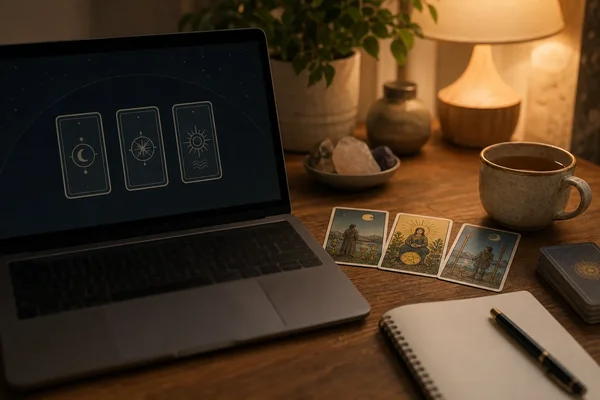
Yes. A free online three card spread can be a convenient way to practice when you do not have a physical deck nearby. Treat the result as a reflection tool, then journal what the cards suggest in your own words.
Do I need to read reversed cards?
No. Reversals are optional. If you are new to tarot, you can begin with upright cards only. Later, you may use reversals to explore blocked, delayed, internal, or intensified versions of a card's meaning.